432 Hz: hear it, then see what it really draws
A pure 432 Hz tone next to the standard 440. Then the honest test: what each one draws in sand on a real metal plate.
Switch between the two while it plays. The difference is about a third of a semitone.
Opens the Lab’s Chladni plate at 432 Hz. Change the frequency or the plate and watch the sand move.
What 432 Hz is
MeasuredIn music, “432 Hz” means tuning the A above middle C to 432 vibrations a second instead of 440. ISO has set A at 440 Hz since 1955, first as Recommendation R 16 and then as the standard ISO 16 in 1975[1]. Before that, concert pitch varied from city to city and decade to decade. 432 is about 32 cents lower than 440, roughly a third of a semitone.
The claims
TraditionFans say 432 Hz is “in tune with nature” or the universe, call it “Verdi tuning”, and say it relaxes the body more than 440. The nature claims are tradition, not physics: the hertz is a human unit, one vibration per second, and the second itself is a human choice. No number of hertz is built into nature.
What the studies say
StudiesVery little. One small double-blind pilot study had 33 people listen to the same music tuned to 432 and to 440 Hz. With 432 their heart rate was slightly lower, by about 5 beats a minute (a borderline result), and they said they felt a little more focused and satisfied. The authors called for larger studies[2].
What 432 Hz draws on a real plate
MeasuredPut sand on a metal plate and shake it at one frequency: the sand runs off the parts that move and gathers along the lines that stay still. These pictures come from the Lab’s plate simulator: a 24 cm aluminium square bolted at its centre, the same kind of setup as the UC Santa Cruz physics demo[3], with its calculations checked against NASA’s plate tables[4].


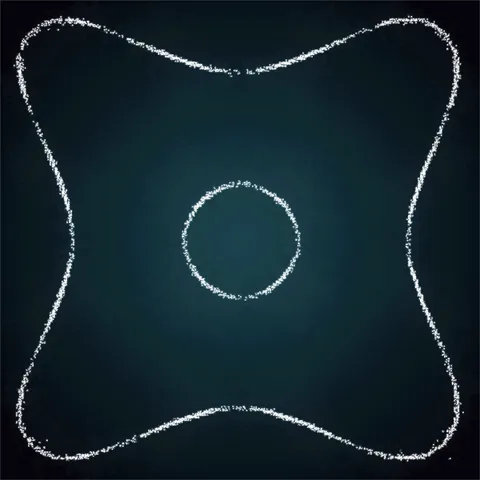
Two things jump out. 432 and 440 draw the same figure: on this plate both sit near the same resonance, at 427 Hz. And the same 432 Hz on a slightly thicker plate draws a completely different figure. The pattern belongs to the plate (its size, thickness, metal and how it’s held), not to the number. Any frequency can draw a beautiful figure on the right plate.
Calm Week
Seven short sessions for a quiet break, ending with Pure 432 on day 7. Day 1 is free.
Questions
Is 432 Hz better than 440 Hz?
Neither is better in a physical sense. Some people prefer how music sounds tuned a little lower, and that’s a real preference. The one study found a small heart-rate difference that still needs testing in a bigger trial.
Is 432 Hz healing?
There’s no good evidence that it heals anything. If you like how it sounds, enjoy it. That’s reason enough.
Why does the same frequency draw different figures?
A figure appears when the frequency matches one of the plate’s own resonances, and those depend on the plate’s size, thickness, material and mounting. Change the plate and the resonances move. See the Chladni plate guide.
What about 528 Hz?
Same story, different number. See the 528 Hz guide.
Sources
- ISO 16:1975. Acoustics — Standard tuning frequency (standard musical pitch). iso.org/standard/3601.html
- Calamassi D, Pomponi GP. Music tuned to 440 Hz versus 432 Hz and the health effects: a double-blind cross-over pilot study. Explore 15(4):283–290 (2019). doi:10.1016/j.explore.2019.04.001
- UC Santa Cruz Physics Demonstrations. Chladni figures. ucscphysicsdemo.sites.ucsc.edu
- Leissa AW. Vibration of Plates. NASA SP-160 (1969). ntrs.nasa.gov/citations/19700009156